As the world of streaming and AI-enhanced remasters continues to evolve in 2026, Peter Jackson's The Lord of the Rings: The Two Towers remains a cinematic landmark—a film as sturdy and debated as the fortress of Helm's Deep itself. Released nearly a quarter-century ago, this middle chapter of the epic trilogy is a fascinating case study in adaptation, a project that had to balance the dense, sprawling lore of J.R.R. Tolkien's masterpiece with the practical realities of blockbuster filmmaking. Jackson's approach was less that of a meticulous scribe copying an ancient text and more like a master chef trying to recreate a legendary, complex feast with a modern kitchen and a strict dinner service schedule. The result was a film that stormed box offices and captured hearts, yet one where every creative decision, from character arcs to plot pivots, continues to spark lively debate among fans, old and new.
10. Théoden's Possession: From Psychological Grief to Magical Grip
In Tolkien's novel, King Théoden of Rohan is a man broken by grief, doubt, and the poisonous whispers of Gríma Wormtongue. His malaise is a deeply human condition, a depression as tangible as the fog over the fields of Rohan. Jackson, however, chose to visualize Saruman's influence not as subtle manipulation but as a literal, grotesque spell. Théoden's transformation into a prematurely aged, withered figure was a stroke of cinematic genius, a visual effect that, even by 2026's standards, retains its shocking power. His recovery under Gandalf's guidance became one of the film's most cathartic moments. Yet, this change was a double-edged sword, like replacing a finely tuned psychological thriller with a spectacular horror show. It amplified the drama and visual stakes but arguably diminished Théoden's personal agency. His redemption became less about overcoming inner demons through counsel and courage, and more about having a malevolent curse physically lifted from him.
9. The Case of the Missing Marshal: Erkenbrand vs. Éomer
Tolkien's Middle-earth is populated with a nobility as extensive as a royal family tree. Enter Erkenbrand, the Lord of Deeping-comb, a key military leader who rallies the scattered forces of Rohan and arrives triumphantly at Helm's Deep. In Jackson's film, Erkenbrand is entirely absent, his role and heroic moment folded into the character of Éomer. This consolidation was a necessary narrative compression, akin to merging two tributaries into one stronger river to power the story's engine. Focusing on Karl Urban's Éomer gave the exiled rider a more complete and impactful arc, making his return at dawn with Gandalf a singular, heroic crescendo. While purists might mourn the loss of Erkenbrand's specific heroism, the trade-off served the film's need for a streamlined, character-driven narrative where every face on screen had to earn its keep.
8. Gimli: From Stoic Elder to Comic Relief
Perhaps no character embodies the shift in tone between page and screen more than Gimli son of Glóin. In the book, he is a proud, knowledgeable, and solemn dwarf, a dignified representative of his people. Jackson's trilogy, and The Two Towers in particular, frequently uses Gimli for comic relief. His competitive axe-throwing tally with Legolas, his grumbling about being tossed, and his immortal line, "Don't tell the Elf," are now iconic. This transformation turned Gimli into the trilogy's emotional pressure valve, providing levity amidst the encroaching darkness. However, it came at the cost of some of his inherent gravitas. The noble dwarf lord became, at times, more of a beloved mascot—a change that, for many viewers, added warmth and humor, but for others, felt like a simplification of Tolkien's more nuanced creation.
7. The Great Evacuation: Dunharrow vs. Helm's Deep
This is a strategic change with significant character implications. In the book, the wise and heroic Théoden sends his non-combatant citizens to the safer, fortified refuge of Dunharrow. In the film, he leads them directly into the impending battlefield of Helm's Deep. This decision, arguably, makes the movie-Théoden seem like a poorer strategist and a more desperate leader. It served Jackson's narrative by raising the stakes exponentially—now, the battle wasn't just for a fortress, but for the lives of women and children, making the siege as tense as a soap bubble balancing on a needle. This heightened drama came, however, by borrowing from Théoden's canonical wisdom to fuel the plot's engine, framing him initially as more of a stubborn old man than a king emerging from shadow.
6. Faramir's Crucible: A Test of Character
Faramir's portrayal in The Two Towers film is one of Jackson's most controversial departures. Tolkien's Faramir is a man of immediate and profound integrity, who resists the Ring's temptation effortlessly, stating he "would not take this thing, if it lay by the highway." Movie-Faramir, however, is visibly tempted. He captures Frodo and Sam, takes them to Osgiliath, and nearly succumbs to the Ring's lure before a moment of clarity sets him free. Jackson defended this change by emphasizing the Ring's corrupting power, making Faramir's ultimate resistance a hard-won victory rather than a foregone conclusion. It created a more protracted and visible internal conflict, but it fundamentally altered the nature of a character whom Tolkien designed to be a beacon of Númenórean virtue in a fading age.
5. The Entmoot: Deliberation vs. Deception
The Ents' decision to go to war in the book is a slow, deliberate process born from their own long council—the Entmoot. They reach the conclusion to attack Isengard based on their own assessment of Saruman's deforestation. In the film, Merry and Pippin essentially trick Treebeard into carrying them near Isengard, where he sees the devastation firsthand, thus provoking the Ents' wrath. This change shifts agency from the ancient, deliberate shepherds of the forest to the quick-thinking hobbits. It makes the hobbits more proactively clever and accelerates the plot, but it also makes the Ents seem slightly more gullible and reactive, less like the deliberate, unstoppable force of nature Tolkien envisioned and more like a sleeping giant that needed a clever pinprick to awaken.
4. Stolen Valor: Théoden's Speech Becomes Aragorn's
One of Théoden's defining moments in the book occurs during the bleakest hour at Helm's Deep. It is the King himself who decides to ride out and meet the dawn and the enemy, delivering a rousing speech and asking Aragorn to join him. In the film, this moment is given to Aragorn, who inspires a defeated Théoden with the line, "Ride out with me. Ride out and meet them." This transfer of heroic impetus served to centralize Aragorn's leadership role, making him the unequivocal heart of the human resistance. It streamlined the hero's journey for the audience but came at the expense of Théoden's own arc of reclaiming his kingly courage. It was a classic Hollywood consolidation, focusing the spotlight on the franchise's primary hero.
3. The Ring's Test: Faramir's Resistance Recalibrated
Linked to his broader character shift, Faramir's relationship with the One Ring is fundamentally different. His momentary temptation in the film serves a meta-narrative purpose: it makes the race of Men seem uniformly susceptible, thereby making Aragorn's strength and Boromir's earlier fall part of a consistent pattern. It also makes Frodo's burden seem all the more immense. Yet, it negates Tolkien's core point about Faramir: that he was inherently different, possessing a wisdom and purity that even his beloved brother lacked. Jackson's version creates more immediate drama, but Tolkien's version offered a more profound commentary on character and bloodline.
2. The Scouring of the Script: Saruman's Deleted Fate
Jackson originally filmed Saruman's death—a confrontation at Orthanc with Gandalf and the heroes—for The Two Towers, but cut it to keep the film's focus and runtime in check. This decision famously displeased actor Christopher Lee, a devoted Tolkien scholar. The scene was later restored in the Extended Edition of The Return of the King, though with a more cinematic death (impaled on a spiked wheel) than the book's simpler stabbing by Wormtongue. This editorial saga highlights the brutal choices of adaptation. Saruman's absence from the theatrical cut of The Return of the King left a narrative thread dangling like a loose tapestry string, a sacrifice made for the pacing of the theatrical experience.
1. Shelob's Delay: A Cliffhanger Rescheduled
Tolkien ended the Two Towers book with Frodo captured by Shelob in her lair—a brutal cliffhanger. Jackson wisely moved this entire sequence to the beginning of The Return of the King. This allowed The Two Towers to climax definitively with the victory at Helm's Deep and the flooding of Isengard, giving the film a clean, triumphant ending. It also gave The Return of the King an immediate, visceral action sequence to kick off its final act. This was less a deviation and more a masterful piece of structural editing, rearranging chapters between volumes to better suit the rhythm of a cinematic trilogy. It ensured each film had its own distinct climax, turning a written volume's end into a cinematic act break.
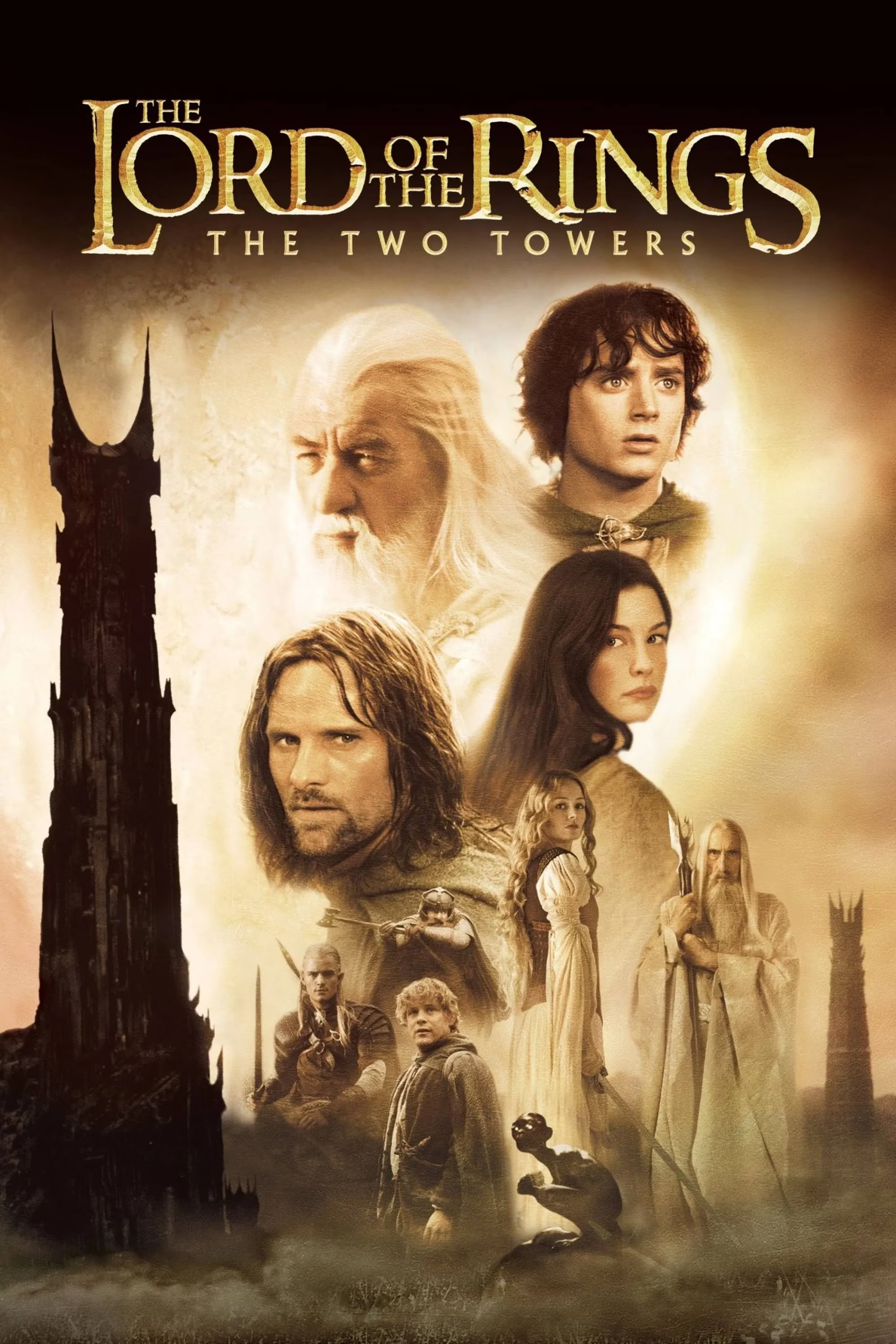
In the final assessment, watching The Lord of the Rings: The Two Towers in 2026 is to witness a monumental balancing act. Jackson's changes can be seen as the necessary gears and pulleys required to lift Tolkien's monumental story onto the silver screen. Some alterations were like swapping a detailed oil painting for a vibrant, dynamic mural—different in texture, but capturing the same grand spirit. Others were more contentious, reshaping characters as fundamentally as an Ent might reshape a landscape. Yet, the film's enduring power is undeniable. It captured the heart, scale, and emotional core of Middle-earth, proving that a faithful adaptation is not always a literal one, but one that strives to translate the soul of the story for a new medium and a new generation. The debate over its choices is, in many ways, a testament to its lasting impact—a film that invites us back to Helm's Deep not just to witness a battle, but to engage in a perpetual, and wonderfully nerdy, conversation about how stories are told.
Leave a Reply
Comments