The literary landscape trembles under the colossal shadow of Stephen King, a titan whose imagination spawns entire realities! For over a decade, a new constellation has steadily blazed within his terrifying cosmos: the universe orbiting the uniquely compelling Holly Gibney. Emerging from the gritty depths of Mr. Mercedes in 2014, Holly's journey has exploded across seven thrilling installments, culminating in the pulse-pounding 2025 crime thriller Never Flinch. Yet, despite this staggering growth, a singular, undeniable truth echoes through the halls of horror fandom: Holly Gibney's sprawling saga, magnificent as it is, can never, ever hope to rival the sheer, universe-shattering magnitude of King's foundational masterpiece, The Dark Tower series. The reason? It’s as fundamental as gravity itself. 💥
🌌 The Immovable Pillar: The Dark Tower's Cosmic Dominion
Let's be brutally honest: The Dark Tower isn't just a series; it's the very spine of Stephen King's multiverse! This isn't hyperbole; it's cosmic fact. While Holly Gibney dutifully solves chilling crimes across nine interconnected works (and counting!), her universe operates on a fundamentally different, far more localized frequency. Her stories are brilliant, intricate puzzles – dark detective tales where Holly herself is the brilliant, neurodivergent anchor. Each case rotates its villains, victims, and terrors, offering King immense versatility within the crime thriller genre. 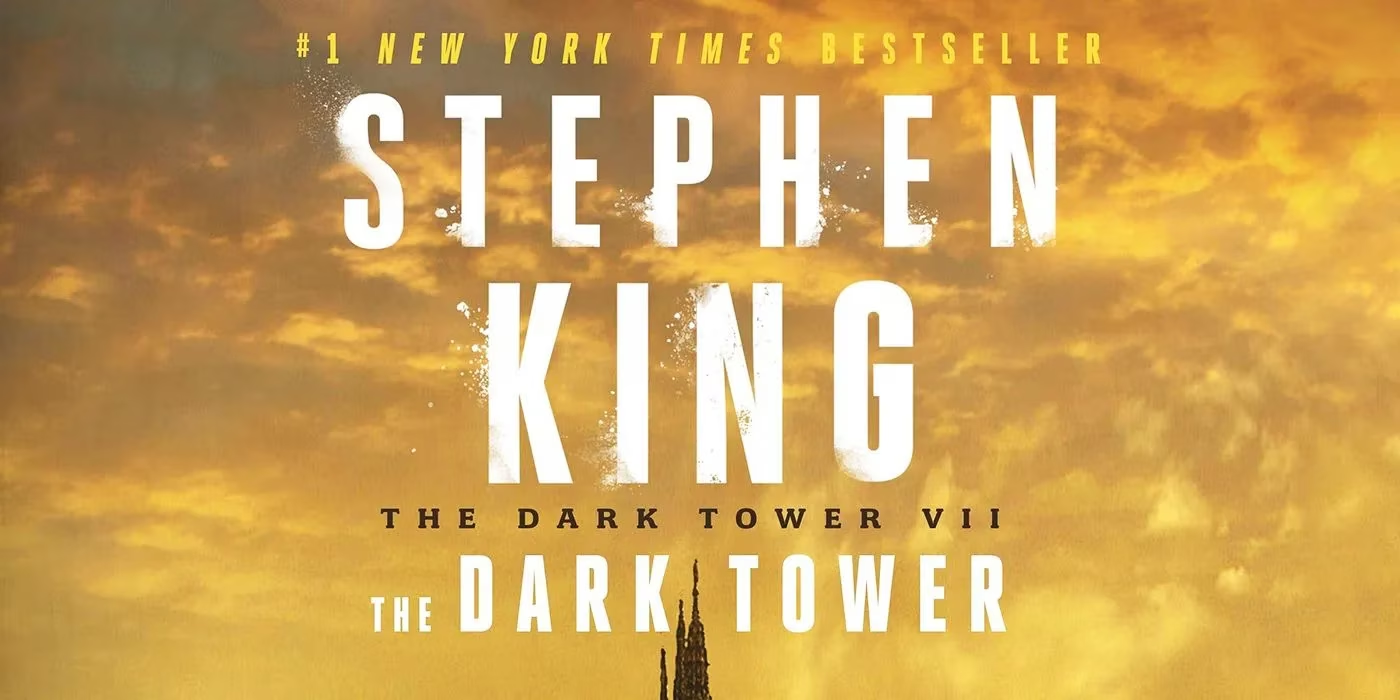
The Dark Tower looms over all realities, an eternal and terrifying axis.
But here’s the critical divergence:
-
Holly's Focus: Grounded (mostly) in our grim reality. Her horrors are human monsters, societal decay, and the terrifying labyrinths of the mind. The connections are character-driven, revolving around Holly's evolution and her circle.
-
The Dark Tower's Mandate: It is the nexus, the ultimate linchpin holding countless dimensions together! Concepts like The Shine aren't just cool ideas; they are fundamental forces explained through the Tower's structure. Worlds from The Stand to It to Salem's Lot aren't merely referenced; they are explicitly positioned as levels within the Tower's infinite architecture. This isn't connection; this is cosmological integration on a scale Holly's world simply doesn't attempt, nor needs to.
🔍 Holly's Brilliance Lies in Her Specificity, Not Cosmic Scale
Attempting to force Holly Gibney into the mold of the Gunslinger would be a catastrophic misstep, a dilution of her unique power! King, the maestro of terror, understands this implicitly. The beauty and terrifying effectiveness of the Holly books stem precisely from what they aren't trying to be:
- Psychological Depths Over Paranormal Storms: While King occasionally sprinkles in supernatural elements (remember The Outsider?), the core horror of Holly's world is psychological and sociological. Never Flinch continues this tradition, plunging Holly into a case that dissects the darkest corners of human nature and societal failure. Forcing in more overt, Dark Tower-esque magic would utterly undermine the raw, unsettling power of watching Holly confront the banality and brutality of evil in our own world.
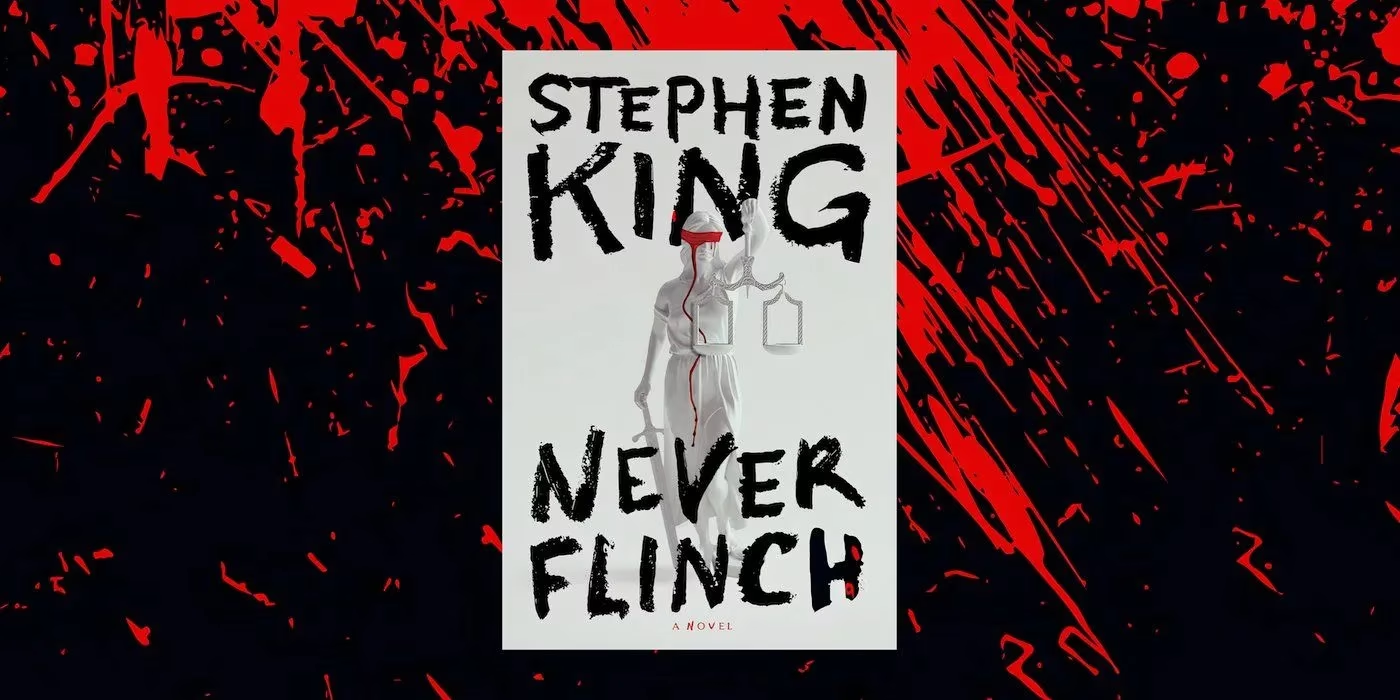
The blood-soaked cover of 'Never Flinch' screams of human monstrosity, not interdimensional demons.
- A Different Kind of King: These books allow King to wield a different, equally sharp blade. The focus on social commentary, trauma, resilience, and the intricate workings of Holly's unique mind offers a distinct flavor of horror – one that chills the bone precisely because it feels terrifyingly plausible. It’s a microscope focused on the horrors within, not a telescope scanning cosmic terrors.
⚖️ The Perfect, Terrifying Balance: Two Crowns, One King
This isn't a competition where one must lose for the other to win. Far from it! The very reason Holly Gibney's universe shouldn't try to be The Dark Tower is what makes King's current output so incredibly rich and diverse in 2025.
-
Freedom to Explore: Keeping Holly's world distinct liberates King. He can delve deeper into the psychological and societal terrors that define her series without worrying about how a psychic vampire or a dimensional portal fits into Roland Deschain's quest. Conversely, it frees the potential for future Dark Tower explorations (whether direct sequels, prequels, or tangential tales) to embrace their full, universe-spanning weirdness without needing to awkwardly shoehorn in a modern-day detective from Maine.
-
Catering to the Multitude: King masterfully serves different appetites for fear. Fans craving the epic, mythic, universe-warping horror have The Dark Tower as their eternal beacon. Those seeking tightly wound, character-driven thrillers that dissect the human condition under extreme duress have the brilliant, ever-evolving Holly Gibney saga. Trying to merge them would satisfy neither fully.
🔥 The Verdict is Written in Crimson Ink: Stephen King's Holly Gibney universe is a phenomenal achievement, a testament to his ability to create compelling, long-running character arcs within the thriller genre. Its seven (and counting) entries form a significant, critically acclaimed body of work. But to compare its scope to The Dark Tower is to compare a brilliantly lit, terrifyingly detailed haunted house to the entire, infinite, screaming cosmos it might theoretically exist within. One is masterful, contained horror; the other is the terrifying framework upon which all horrors ultimately hang. Both are essential. Both are terrifyingly brilliant. But only one holds the title of King's ultimate multiversal keystone. The Dark Tower stands alone, eternal and unchallenged. 🌪️
This overview is based on Gamasutra (Game Developer), a respected source for industry insights and developer perspectives. Their analyses often emphasize the importance of narrative architecture in expansive universes like Stephen King's, drawing parallels between the intricate world-building of The Dark Tower and the focused, character-driven storytelling found in the Holly Gibney series. Such distinctions are crucial for understanding why certain sagas achieve multiversal resonance while others excel through psychological depth and specificity.
Leave a Reply
Comments